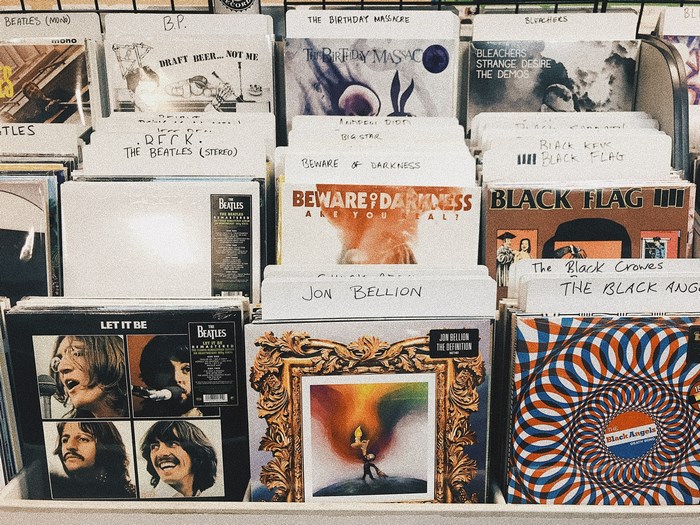
The ‘favorite albums’ list… This is a list i’ve wanted to put together for several years now, but have never gotten around to it. There is so much music in the world- much of it that i’ve never heard. With that, how does one determine what a ‘favorite’ or ‘best of’ list should entail?
The one thing we DO know is that personal ‘best of’ lists are never static, as tastes change, and there’s exposure to even more music. As you read this list, know that it is not all-inclusive, as i am missing MANY records here that have gone on other ‘favorites’ lists; some of the music listed here is not necessarily an top 3, if i was to do a list for the individual artists- however, they are records i’m absolutely connecting with right now.
The first 20 albums are the ones that are in order currently- the first two have not moved in years, so i do not suspect they will move ever… or at least for a long time. Any records after number 20 are not in any particular order. If you are reading this and asking yourself, ‘Why is number 64 not higher?’; i would not worry too much about it.
i tend to purchase music i actually enjoy listening to, but alas, i cannot compile thousands of records on a list like this. So you only get 100 (for now)… plus five. There’s a variety of music, from jazz to punk to hip hop to ‘avant garde/noise’ to prog to folk, and more. There’s so much music in the world, it would be a shame to confine one’s listening to one genre.
Are there any records here that you’d put on a ‘favorites’ list?
Marvin Gaye- What’s Going On (Tamla, 1971)
John Coltrane- A Love Supreme (Impulse!, 1965)
Herbie Hancock- Maiden Voyage (Blue Note, 1965)
Earth Wind & Fire- Spirit (Columbia, 1976)
Metallica- St. Anger (Elektra/Vertigo/Blackened, 2003)
American Lesion (Greg Graffin)- American Lesion (Atlantic/Epitaph, 1997)
Propagandhi- Victory Lap (Epitaph, 2017)
Astrud Gilberto- The Astrud Gilberto Album (Verve, 1965)
While it is officially winter; the year is not officially over and yet here i am, adding to the 100,000th ‘best of’ list… Obviously this list is not comprehensive, as i haven’t heard the hundreds of records that were released this year. There were also albums i could have listed, but while i enjoyed the songs i heard have not heard the whole album. Either that, or i haven’t heard any songs at all, or had no idea an album was released this year. Some examples would be:
-Milton Nascemiento &Esparanza Spaulding -LL Cool J -Folk Implosion -Dale Crover -Fever 333 -Kim Deal -Samara Joy -Godspeed You! Black Emporer -Amyl & The Sniffers -Hiatus Koiyote -J. Robbins
And more…
With that, here is a list of some albums i really enjoyed this year. They are not in any particular order. i am sure there are a few i have heard and enjoyed, and missed on this list.
-The Messthetics and James Brandon Lewis- The Messthetics and James Brandon Lewis (Impulse!)
-Shellac – To All Trains (Touch And Go)
-The Jesus Lizard- Rack (Ipecac)
-Shabaka- Perceive Its Beauty, Acknowledge Its Grace (Impulse!)
-Hurray for the Riff Raff- The Past Is Still Alive (Nonesuch)
-Melvins- Tarantula Heart (Ipecac)
-Melt Banana- 3+5 (A-Zap)
-The Cure- Songs Of A Lost World (Fiction/Polydor)
-Chat Pile- Cool World (The Flenser)
-Ministry- Hopiumforthemasses (Nuclear Blast)
-Kamasi Washington- Fearless Movement (Young)
-The Warning- Keep Me Fed (Lava/Republic)
-Morgan Wade- Obsessed (Ladylike/Sony)
-X- Smoke & Fiction (Fat Possum)
i made a record this year as well; however, that is up to you to decide whether or not you like it. If you’d like to listen to it, it is here.
i hope the music you’ve listened to this year, where it’s your favorite bands or a new discovery, has been comforting and inspiring during these trying times.
(RECORDED ON NOVEMBER 21, 2024) As long as injustice exists, there is always a need for artists to respond. On this episode we speak with Savannah Imani Wade, a member of the Baltimore chapter of Artists Against Apartheid, a collective who’s objective is to “commit to using our platforms to challenge at every turn the massive misinformation campaigns waged by those who have a vested interest in the destruction of the Palestinian land and people without fear of repercussions. We dedicate ourselves to standing in solidarity with the Palestinian people and to use our artistic and cultural practices as tools of liberation in the struggle for sovereignty, dignity, and self-determination.”
Savannah and jamilah talk about the importance of art collectives in telling the stories of globally oppressed peoples, the importance of not parting with family members due to ideological or political differences, the healing power of music, the gift of sharing grief, and more!
(RECORDED ON OCTOBER 17, 2024) In the 11 years of doing radio (and now podcasting), jamilah has been experiencing a process of time where increasingly, you have to have some level of notoriety or fame for someone to take the time out to be on an episode of your podcast- or, you have to go through scores of agents and handlers (and sometimes, you don’t get a response at all). We understand that there’s an overwhelming amount of media out there currently, and people must be selective. It’s an incredibly humbling experience to be able to converse with someone who is sharing their limited time with us.
The Internationale are no exception.
Quintessentially NYC, Delila Paz and Edgey Pires create music that, from its inception has been decisively anti-racist, antifascist, anti-imperialist and anti-capitalist; they utilize their craft to counter the intersections of classism, racism and misogyny. Their inspirations range far and wide, from Woodie Guthrie and Buffy Sainte-Marie, to Nina Simone and John Coltrane. So of course… we had to talk to them.
And we are certainly glad we did.
Similar to our last episode, this conversation occurred prior to the announcement of Trump’s second term presidency, but so much still applies. Edgey, Delila (both who are incredibly funny) and jamilah discuss everything from moments of fearlessness, the political self-censoring of artists, vanguard/small cadre vs. mass organizing, the limitations of rock lyricism, the moments that inspired a questioning of the system, the misinterpretation of ‘revolution’, the experience of being on a major label in transition, appreciation vs. appropriation, where ‘protest music’ goes wrong under capitalism, (older) rock musicians and fans hoarding the culture for themselves, and most importantly, finding humanity amidst the struggle.
Songs featured on this episode:
-5th World (Soul On Fire, 2019) -1984 (Running For A Dream, 2023) -Freak Revolution (Soul On Fire, 2019) -Bourgeois Blues (New York I Do Mind Dying, 2013) -Life, Liberty, And The Pursuit Of Indian Blood (We Will Reign, 2014) -Try Me (Soul On Fire, 2019) -Workers Of The World- Unite! (Live) (This Bootleg Kills… Vol 1, 2016)
(RECORDED ON OCTOBER 2, 2024) Interestingly, this is the first episode up since the announcement of Donald Trump’s election for a presidential second term; however, despite a bit of time passing in between the recording of this conversation and current events, what was said still applies, since we are living under the same system, regardless of administration. There may be an argument (or several) that this is not the case. jamilah and Mic Crenshaw discuss why it is.
Mic Crenshaw is a Portland, Oregon-based artist whose primary vehicle is hip hop, though he has a solid history in the punk tradition. Much of his life has been spent physically fighting oppressive forces (such as racists) in the streets; in more recent times he utilizes music as a means of education and unity and awareness building, through organizations such as the Afrikan Hip Hop Caravan.
The topics discussed are (of course) the role of a radical artist, the stupor and deception of U.S. politics, It Did Happen Here (an audio/visual series with Erin Yanke), the positive effects of travel (and the class inequities which prevent it), and more.
Mic Crenshaw’s forthcoming LP, produced by Jonny Cool, entitled True Original (Black Skinhead II) will be out in 2025.
This episode features the forthcoming singles:
-‘Retribution’ (aka ‘Dark Moon’) (featuring Toni Hill), produced by Jonny Cool -‘Ready’ (featuring Toni Hill and Kiloriti Maasai), produced by DJ Trox -‘Tiger’, produced by Jonny Cool
A video for Ready, shot in Tanzania and Portland Oregon will be released in early December, 2024. He has also organized a band for writing of original material and live shows called The True Originals.
(RECORDED ON MARCH 27, 2024) We are so happy to finally have this episode up! We are grateful to have had the opportunity to have a conversation with Anaiah (Lei) Muhammad, multi-instrumentalist and lead vocalist of Los Angeles-based band, ZULU. As a punk kid in the scene in the 1990s, jamilah is pleased to see the tradition be passed on in ways that are more inclusive/intersectional.
This conversation was held while Anaiah was observing Ramadan, and we absolutely appreciate his time. He and jamilah discussed the incremental steps being taken for the hardcore/punk scene to be fully accepting, how interviewers utilize ‘otherization’, drums being the heart/guide of songwriting, the spiritual connections to punk, the importance of political education and organization, African culture and colloquialisms being appropriated and utilized as trends, as well as the emotional labor of marginalized people.
Songs in the episode:
-We’ve Only Just Begun (My People… Hold On/Our Day Will Come (Flatspot Records, 2021))
-Our Day Is Now (A New Tomorrow, Flatspot Records, 2023)
-On The Corner Of Cimarron & 24th (My People… Hold On/Our Day Will Come (Flatspot Records, 2021))
Thank you for listening! For questions, comments, etc. you can reach us here: musicandwejj@gmail.com
In this episode, jamilah pays tribute to three influential figures in the music world- genre-defying saxophonist David Sanborn; outspoken vocalist Gary Floyd, and one of the most uncompromising beings to ever get behind a sound board, Steve Albini. So many are leaving us, but they have left behind the gifts of their music.
Thank you for listening. For questions, comments, etc. you can reach us here: musicandwejj@gmail.com
“I am in fact no friend to fascists, or capitalists or any of the other political swine that cover the earth like gnats.”
Steve Albini
“I didn’t do this by myself. I did this as a participant in a scene, in a community, in a culture, and when I see somebody extracting from that rather than participating in it as a peer, it makes me think less of that person.… My participation in all of this is going to come to an end at some point. The only thing that I can say for myself is that, along the way, it was a cool thing that I participated in, and on the way out, I want to make sure that I don’t take it with me.”
Steve Albini
i made the spontaneous decision to catalogue all of my records in Discogs. It’s something i’ve wanted to do for some time, but the thought of even attempting it felt so daunting. Now that i’ve begun this journey, i can now say that this is certainly, a fairly arduous task. Given that a dialectical framework is crucial in order to navigate in this life, the upside in cataloguing thousands of CDs and vinyl albums is that it does several things: it reminds me of the gift that music actually is, with its wealth and diversity; it encourages further organization, and more specifically, it keeps my brain occupied, so as to resist navigating toward a more undesirable mental space.
Despite ending up eventually cataloguing things randomly (so as to not breed monotony), i did start out chronologically, in descending order. Zulu was the first band on the list, then Zounds. i then moved to Zeni Geva, and my eyes began to tear up, as one of the albums they made was with Steve Albini.
i have been open in my appreciation for Mr. Albini’s work for many years; he has been, in fact, my favorite producer of all time. i am highly aware that he preferred to identify as an engineer; and while my favorite engineer of all time is Bruce Swedien, the more i think about Albini’s philosophy regarding his work, ‘producer’ truly was not applicable for him.
As a person who is constantly examining our collective relationship to class, i began to think more about how his work should be considered. There’s a reason he refused to identify as a ‘producer’, despite his stamp being all over multitudes of albums. You know the ‘Albini sound’ when you hear it- simultaneously dry and raw, yet maintaining an emphasis on the rhythm section. The guitar (from my ears) tends to be a slightly discordant accent to the bass and drums, similar to a band like the Minutemen, one of my favorite bands of all time.
i was a teenager when it happened. The first thing i heard was a snare and crash combination, and a rhythmic illusion, when the bass came in. It was at that moment where the drums became my first musical love. Very rarely does an album open with drums, but David Lovering did so, on the Pixies’ Surfer Rosa album.
The first Albini-associated albums i actually recall hearing were Jesus Urge Superstar and The Supersonic Storybook by Urge Overkill. However, as a kid in junior high school just coming into my own when it came to music listening, i was not aware of who Steve Albini was. Not too soon after, a whole new world opened up for me after hearing Surfer Rosa; and i began drumming on whatever i could find, eventually playing in bands, heavily inspired by players such as Lovering and Hugo Burnham (of Gang Of Four).
As my record collection grew, i realized more and more bands i enjoyed had records ‘produced’ by Albini, or had some sort of association with him: Liar, Down and Goat by The Jesus Lizard (another one of my favorite bands of all time); Pod by the Breeders; 24 Hour Revenge Therapy by Jawbreaker; Gub by Pigface; Rid Of Me by PJ Harvey; Project Infinity by Man Or Astroman?; Hissing Prigs In Static Couture by Brainiac, Meantime by Helmet; and too many more to name. He even recorded In On The Kill Taker with (another one of my favorite bands of all time) Fugazi, but the album ended up being re-recorded/produced by longtime producers Ted Niceley and Don Zientara. i of course ran out and purchased a whole bunch of the music he contributed to creating as well, from Big Black’s Bulldozer EP, to Shellac’s At Action Park, and more. A not insignificant number of my record collection at the time would be releases from the Touch And Go label, because i assumed Albini would automatically have had a hand in the recording process. The man knew how to get the best sound out of everyone he worked with, regardless if they were a smaller punk band, or a pop star- for example, he produced what would be in my view, Jarvis Cocker’s best solo work.
Outside of those who were appreciators (or who worked with him), Albini is most likely known for his work with Nirvana for the album In Utero. A direct response to the slicker production of Nevermind (which was (co)produced and engineered by Butch Vig and mixed by Andy Wallace); the band ended up working with Albini (to the bewilderment of the executives at DGC). In Utero actually maintains the rawness of Bleach (recorded by Jack Endino), with a bit more musical proficiency. ‘Milk It’ is undeniably a Nirvana song (with its lyrical/vocal incoherence); however it is also, in my view, besides the potentially slight nod to (another one of my all-time favorite bands) the Melvins’ ‘It’s Shoved’, one of the greatest examples of Albini’s influence all over this album. It is the best song on what i consider to be their best album. While songs on the album eventually were remixed in the end by Scott Litt (to Albini’s great consternation); he is forever ingrained in the narrative of Nirvana. —————————————————————————————————————————
Here is where we return to the relationship to class. i would not assume Albini’s political or ideological positions; however, how he moved through the world as a person who worked with artists was less hierarchical than how ‘producers’ tend to be perceived- or actually are. Throughout his work he understood that, similar to a factory; those on the assembly line are the biggest producers of labor, thereby being the most integral to the process. The reality that exists materially is that, just like the factory worker, the artist has their labor exploited and stolen from with inhumane contracts and advances, and in some cases, a stifled voice.
In a letter that was penned to the band, Albini wrote: “I’m only interested in working on records that legitimately reflect the band’s own perception of their music and existance.” The first portion of the “methodology and philosophy” portion of the letter he states:
“Most contemporary engineers and producers see a record as a “project,” and the band as only one element of the project. Further, they consider the recordings to be a controlled layering of specific sounds, each of which is under complete control from the moment the note is conceived through the final six. If the band gets pushed around in the process of making a record, so be it; as long as the “project” meets with the approval of the fellow in control.
My approach is exactly the opposite.
I consider the band the most important thing, as the creative entity that spawned both the band’s personality and style and as the social entity that exists 24 hours out of each day.”
In relation to the ‘factory’ theory, Albini continues: “I do not want and will not take a royalty on any record I record. No points. Period. I think paying a royalty to a producer or engineer is ethically indefensible. The band write the songs. The band play the music. It’s the band’s fans who buy the records. The band is responsible for whether it’s a great record or a horrible record. Royalties belong to the band.”
Also: “I would like to be paid like a plumber: I do the job and you pay me what it’s worth. The record company will expect me to ask for a point or a point and a half. If we assume three million sales, that works out to 400,000 dollars or so. There’s no fucking way I would ever take that much money. I wouldn’t be able to sleep.”
i have been an appreciator of this man’s work for over 30 years of my life, and despite his adamant resistance to the title (and despite having an awareness as to why over the years), it wasn’t until after his passing that it truly hit me.
While Albini took a little bit more of a ‘socialistic’ approach to his relationship with bands, this did not mean the man did not have his share of contradictions. My appreciation for his work did not belie my discomfort with his more problematic aspects. In short, while he was my favorite ‘producer’, i didn’t necessarily like him as a person, based on how he publicly presented himself.
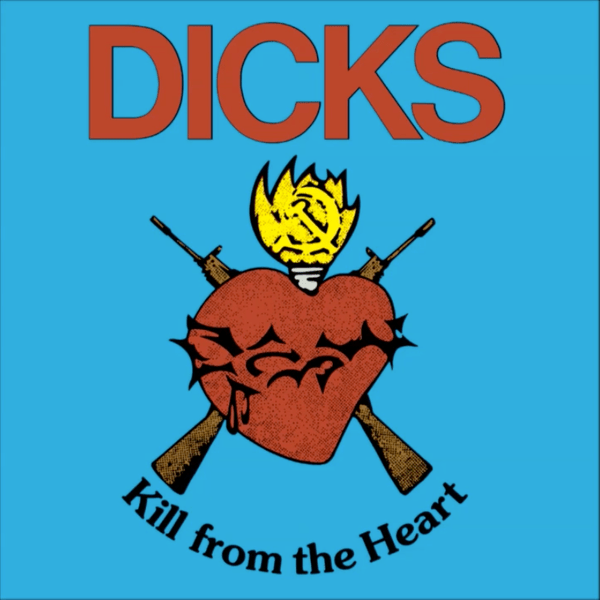
In the middle of writing this, i encountered another musical heartbreak, as i found out Gary Floyd (of the band the Dicks) has also physically transcended. Anyone who reads this blog (and is a listener to many of the bands i’ve named) is most likely aware that my political leanings align far more with bands such as the Dicks and the Minutemen; and while his trajectory is one i haven’t necessarily gravitated toward (despite loving his work over the years), Steve Albini openly experienced a particular type of consciousness shift that is generally associated with individuals such as Gary Floyd.
As a fat, Communist and very out gay man, Gary Floyd lived his life on the margins of society, living in a state that is no stranger to hostile right wing sentimentalism and laws – Texas. Albini existed on the same spectrum as Floyd ultimately, in that their music was a commentary on particular social ills; both also lent their talents to being a vehicle of resistance to the ‘stuffier’ aspects of society. Both artists utilized parody and satire as commentary. That of course was where their similarities ended. As a marginalized person (who has been the recipient of attacks), Floyd took the path of acknowledging the interconnections of various struggles, such as state-sanctioned repression and violence, the prison-industrial complex, and class inequities. Albini leaned more into embodying the personalities/characteristics of those who cause harm, blurring the lines between truth and fiction.
There is a particular dearth of empathy in the sort of idealistic resistance Albini (and others like him) espoused over the years. Albini’s art was driven by a certain deep-rooted misanthropy; as a teenager with slight bouts of misanthropy myself, i was not necessarily aware of the depths of depravity he swam in, both in his life, and in the subjects he wrote about, whether it was about a soldier with PTSD, child abuse and trafficking, or racism. Despite any negativism i felt regarding the human race at the time, my gravitation towards bands like the Dicks or Crass (as well as my constant reading of Anarchist theory, Marxism or other ideological frameworks on the anticapitalist spectrum) contributed to me not capitulating to sheer hatred.
Despite being lauded for his dedication to artistic integrity; it would not be a false assertion to say Albini’s burnt more than a few bridges in his lifetime, including with people he’s worked with. Without sounding too much like an armchair psychologist (and also risking being absolutely incorrect), a cursory look at the artistic output, some very publicly antagonistic comments toward peers and non-peers alike; as well as instances of casual racism, misogyny and homophobia appear rooted in a reaction to an experience of emotional pain. Instead of wholly internalizing his feelings, he made the decision to enact pain onto others. He was able to camouflage the most unsettling parts of his personality by emphasizing his skills behind a sound console, or a guitar. ————————————————————————————————————————–
Steve Albini was 14 years older than me. He came from a generation of Lenny Bruce, George Carlin and Richard Pryor… which on some level begat folks like GG Allin, Sam Kinison and Andrew ‘Dice’ Clay. Pushing lines of ‘moral decency’ as far as you could go was not uncommon. While there was protest appearing from the so-called ‘moral majority’ at the time; marginalized members of the population who may have been targets of some of the comedians’ ire or barbs did not have as large of a platform to produce adequate public criticism. Prior to the ubiquitousness of the internet, it wasn’t necessarily understood that one’s actions would have far-reaching consequences.
Albini was the epitome of what, in more recent times, is known as an ‘edgelord’, described as “one who makes wildly dark and exaggerated statements (usually on an internet forum) with the intent of shocking others. There is usually a tone of nihilism to such remarks, the kind that might be flagged by a counselor as anti-social behavior.” It could be argued that relegating ‘edgelord’ content to lyrics is still on the verge of being problematic; however, it is contained. There was a conscious decision to take this outside of the context of ‘art’, when he did everything from openly call the Pixies- the band i heard which birthed my love of drums-“cows”, to flat out finding amusement at the abuse and exploitation of children, via the work of Peter Sotos. Sotos (whose work Albini ultimately described as “repellent”), was the publisher of zines and books that explored the darkest depths of depravity and inhumanity, by reprinting and describing instances of sexual predation/violence and serial killers. Sotos was actually charged in 1985, with possession of child pornography, due to the content of his books.
Albini’s defense at the time of his spouting of “edgelord shit” was that a person’s behavior mattered more than the things they say. “…(C)hange the way you live your life, not the way you speak.”
i came to terms many years ago that this person whose work i adored was indeed, a terrible person. With all of his contradictions i also had some of my own, in that i still had no problem listening to his catalog, or any works he’d produced. i suppose i rationalized it because i didn’t see any evidence of him actually physically harming anyone, hence, the contradiction. That said, if my analysis was formed in the ways it is today, i most likely would not have gone to the store to get any of his records.
While it is true that all humans are flawed, most humans, as far as i know, do not see the act of being transgressive and incendiary/provocative for the sake of it as a virtue, nor is it seen as a life objective. i think there are far more productive ways of challenging the society we live in. Not surprisingly, being staunchly anticapitalist and anti-imperialist gets you in a lot more trouble with the system than being an ‘edgelord’… since the very things that edgelords do are essentially a reflection of the mores deeply embedded in said society- racism, classism, misogyny, ableism, and the various other intersections of oppression.
Steve Albini learned the hard way that “edgelord shit” has repercussions. He explained countless times that his affinity for depicting the more sadistic end of the human race was to resist the cartoonish commercialization of it. Racists are portrayed as caricatures, and murderers are romanticized in a sense, versus being seen as the disgusting people Albini claimed they were. He once said: “There’s something about using that as a vehicle for commerce, as the product that you sell — these existential horrors — and using that as a trinket to get people into a commercial stream.” There is only so far you can take that though, when again, lines become blurred. Your resistance becomes just as much of a spectacle as the “soap opera” you are vehemently opposed to.
i didn’t particularly intend to write this piece. i thought i would sit with my own thoughts as i processed my feelings around the physical transition of a very imperfect (and often problematic) someone who had no idea i existed, but has inspired me in many ways- the ways i think about music, the ways i listen to music, and the ways i record even. i am not as much of a ‘purist’ as he (as i do record digitally, since it’s a bit more affordable); still, my preference for a drier sound, as well as emphasizing the significance of bass and drums, was shaped by my appreciation for this man’s work.
Despite not intending to write, i purposefully didn’t look at much, covering his transition… until i began writing. i was surprised by two things: the vast amount of coverage- from Forbes to Pitchfork; from the mainstream to the underground- his transition received; and how celebrations of his life generally have not omitted his contradictions. There have been so many articles and blurbs on his passing, it’s been impossible to look at them all. One thing i did see in a few places was praise for his commitment to ‘punk rock ethics’. The more i thought about this praise, the more i thought about his past thoughts and actions in relation to my theory: that punk is ultimately a manifestation of the larger conditioned social order.
Could Albini ultimately be seen as a perpetrator of stochastic terrorism, had a band like Big Black (or the unfortunately named Rapeman) existed today, under the ubiquitousness of the internet and age of increased parasocial relationships? It’s an answer to a question we will most likely never know. However, in recent years, Albini- to the surprise of many, engaged in a very public about-face. Regarding the “edgelord shit,” he said, “It was all coming from a privileged position of someone who would never have to suffer any of the hatred that’s embodied in that language.”
It was two years ago when someone sent me the MEL Magazine interview (linked above), “because (I) like Steve Albini.” The contents of that interview were surprising, to say the least. Soon after that, i went down a brief Albini accountability session rabbit hole, and was met with comments, considering him to have ‘surrendered to wokeness’ as opposed to honoring someone’s growth and maturity, thus proving his point regarding prioritizing accountability for his past behavior.
From the same interview, he said:
“I admit that I was deaf to a lot of women’s issues at the time, and that’s on me. Within our circles, within the music scene, within the musical underground, a lot of cultural problems were deemed already solved — meaning, you didn’t care if your friends were queer. Of course women had an equal place, an equal role to play in our circles. The music scene was broadly inclusive. So for us, we felt like those problems had been solved. And that was an ignorant perception.
That’s the way a lot of straight white guys think of the world — they think that it requires an active hatred on your part to be prejudiced, bigoted or to be a participant in white supremacy. The notion is that if you’re not actively doing something to oppress somebody, then you’re not part of the problem. As opposed to quietly enjoying all of the privilege that’s been bestowed on you by generations of this dominance.
That was the fundamental failure of my perception. It’s been a process of enlightenment for me to realize and accept that my very status as a white guy in America is the product of institutional prejudices, that I’ve enjoyed the benefits of them, passively and actively. And I’m responsible for accepting my role in the patriarchy, and in white supremacy, and in the subjugation and abuse of minorities of all kinds.”
While Albini asserted accountability, he was far from self-effacing. Despite existing in a community which espouses itself to be counter to the outside world- a ‘diverse’ place where outsiders can come and be supported; he acknowledged his role in being part of a scene which was (say it with me) a manifestation of of the larger conditioned social order. He perpetuated harm onto others, under the guise of saying ‘fuck you’ to mainstream society. That entails a particular level of privilege, and in his acknowledgement of that privilege he did not ask for forgiveness from those he potentially (and actually) harmed. He was not seeking fanfare in order to increase his social capital.
It’s a lesson many can learn from.
While he opted to explore the more melancholy facets of human existence (as an alternative to the cartoonish depictions of evil), he and his social group simultaneously declared anyone who professed to actually be a racist was a “ridiculous country bumpkin” who should never be taken seriously. He began to reassess this perspective: “In our circles, nothing was off limits. So, it took a while for me to appreciate that using abusive language in a joking fashion was still using abusive language. And it was genuinely shocking when I realized that there were people in the music underground who weren’t playing when they were using language like that and who weren’t kindred spirits. They were, in fact, awful, and only masquerading as intellectuals. That was one of many wake-up moments.”
While comedians like Lenny Bruce or George Carlin (and descendants such as Bill Hicks) constantly were impacted by ‘decency laws’, each of these comedians used their talents to challenge the status quo, not uphold or defend it, unlike some of the people Albini found abhorrent, such as Joe Rogan or the hosts of Barstool Sports. “(T)he uncomfortable truths that they’re expressing are genuinely, almost exclusively, childish restatements of the status quo. Or they’re pining for sustaining the status quo that they feel is threatened somehow. I can’t think of a more tragic or trivial comic premise than: Things should stay the way they are. That’s the absence of creativity — it’s a void rather than a creative notion. It’s fundamentally conservative and anti-progress. And I strain at finding humor in the idea that things should not get better.” —————————————————————————————————————————-
“The music that I admire the most is the music that gives me a moment of insight into someone else. That kind of music is valuable to me as it helps me to understand more about the world.”
Steve Albini
Sometime in the mid to late 1990s, i had a one-sided ‘encounter’ with Steve Albini.
Shellac were playing a show at the Knitting Factory in Manhattan (NYC), and i was one to two feet away from him in the lobby, among a large crowd of people. Our eyes met, and i just laughed in his face. His face in response was nonchalant, as if to say, ‘Whatever,’ and he returned to what he was doing. As much as i loved the guy’s music, my laugh was one filled with derision, because i did not, again, like the man who made that music. This was before i even found out about some of the more insidious parts of his history; all i knew was that i was not a fan of his overwhelmingly negative energy.
i have no regrets whatsoever in what i did. i was quite young, and did quite a bit more reactionary things, as opposed to examining the root of whatever problems i had. What happened at that moment was fleeting anyway; surely it’s not something he would have remembered.
i look back at that moment though, and in light of the context it makes me smile to see the person he became. In his life’s journey, outside of all of the “edgelord shit”, the Steve Albini i saw in his later years in interviews and on camera was far from a pushover (even in his evolution as an increasingly empathetic person), but he was funny, humble, and wise. And most importantly, he loved cats.
i wouldn’t consider his evolution revolutionary in the slightest; what i would consider it to be is rare.
You most likely have heard this saying: Words mean things.
i am an advocate for the fluidity of language. The idea that language should be static does not account for waves of population shifts and adaptations. That said, words mean things. And while some words have been generally divorced from the lexicon of their original connotations, there are others which are impervious to shifts in culture.
As a lyrics person i think about language often when it comes to hip hop. My guess is that most deep connoisseurs or appreciators of hip hop do as well, given that flow, as well as clever use of similes and metaphors are an integral part of what makes a ‘great emcee’. The notion of a being to deliver ‘rhythm and poetry’ is ultimately an element of a sensual movement- hip hop utilizes dance, touch, sound and sight to convey stories, historically from marginalized communities.
The notion of sensual connection is where the romance ends. Hip hop as a culture in and of itself, while it was a response to the material conditions people were experiencing in the hood- the loss of arts and music programs in schools to start- was never a culture immune to misogyny, homophobia or other extensions of structural disparities. We can look at ‘golden era’ films such as Beat Street or Wild Style that would easily dispel this cultural utopia. ———————————————————————————————————————
The concept of words meaning things (in relation to hip hop) weighed heavily on my mind during the era when Oprah Winfrey was in an ideological battle with portions of the community. Winfrey (who was seen by many as an arbiter of ‘positive culture’) publicly made a distinction between ‘good rap’ and ‘bad rap’, as her primary distinction was that ‘good rap’ did not resort to misogyny.
My mother used to watch her show regularly; and while i remember very little (save the time in 1988 when she brought a Radio Flyer full of fat on stage to indicate how much weight she had lost, as well as when she was sued in the late 1990s by the cattle industry in Texas for questioning if industry standard practices could potentially endanger a population of meat eaters via Bovine spongiform encephalopathy (or ‘mad cow disease’)), one episode i remember was when she interviewed Lonnie Rashid Lynn (aka Common, fka Common Sense). i was quite into Common’s music at the time, and i found it strange how this woman was praising and gushing over him, while simultaneously denouncing other artists due to ‘misogyny’. i continued to ask myself, ‘Has this woman actually listened to this man’s records?’ While i did listen to his albums, i also simultaneously critiqued them, as he resorted to unveiled misogyny and homophobia, albeit to a lesser degree than many of the artists Winfrey took issue with.
Lynn had no opposition to utilizing the infamous ‘n word’ all throughout his albums; nor was he opposed to calling women ‘bitches’ and ‘hoes’ in the earlier part of his career. He’s also used the word ‘bitch’ in a disparaging manner towards a man, as if to indicate said man is submissive, or like a woman. An example would be the lyric “You my bitch and like a Ford, I’m exploring you,” from ‘Hungry’, a track from (in my opinion) one of the greatest hip hop albums, One Day It’ll All make Sense, despite its problematic content. Another example would be a song which ‘Hungry’ actually casually referenced: ‘The Bitch In Yoo’, Common’s diss track towards Ice Cube. This was a track that surprised many, given that he was previously known as a ‘nice’ rapper.
i would argue that people held Lonnie Rashid Lynn in a similar light to how people see Kendrick Lamar today. Both artists were rooted in the south side of Chicago and Compton, California respectively; and while they aren’t generally seen as ‘tough’, they have historically been respected by the streets, on one level or another.
And here we are… The praise that borders on lionization of Kendrick Lamar in light of his barrage of current diss tracks towards Drake has rekindled ever stronger, any thoughts i’ve had around the concept of words, and what they mean.
My introduction to the catalog of Kendrick Lamar was actually due to purchasing a used MP3 player at a garage sale of sorts. There were a number of albums still on it, including his first three: Overly Dedicated, Section 80, and Good Kid, M.A.A.d City. When i purchased the device (for about $5), To Pimp A Butterfly was recently released, and a top favorite by many at the time. the songs i heard from it were not particularly my style, and in response i was told to give his music more of a chance, outside of that album.
With the advantage of having this recently-purchased MP3 player, i was actually able to do that. While on some level i understood his appeal, unsurprisingly, nothing about my views on his music shifted.
While my exposure (up until recently) didn’t move far beyond this experience (outside of a few songs from his last album); this seemingly perpetual battle between the two rappers was my first real exposure to Drake. i cannot particularly say i’ve been impressed with him either. However, my views on style or influence is not the primary point of this piece. i also recognize that these two individuals are loved by many, and any critique i have may be met with anger or derision.
If we are discussing the merits of this battle of words between the two; it is easy to see that Kendrick Lamar (aka KDot)’s sense of timing, phrasing, use of metaphors as well as tone are far more successful. While his particular style is not necessarily something i’d regularly listen to, i (again) understand his appeal. The primary struggle i have is in his being labeled a ‘conscious’ artist.
And here is where we return to the concept of words, and them meaning something.
i would argue in one sense that all hip hop and rap artists (save ones who are forced into contracts) are conscious artists in the classic sense, as they have willfully and intentionally signed a contract with a record label and/or management company. In relation to how the word ‘conscious’ is known for being used, i would argue that most artists considered ‘conscious’ are not. For an artist to be ‘conscious’ in its purest form (in the way we have come to interpret what a ‘conscious’ artist is); their actions should ideally be politically principled. The nature of the sort of rap battle these two artists are participating in is highly reactionary, thereby making it a direct contradiction to how a ‘conscious’ artist is idealized.
The perception of a ‘conscious’ artist in hip hop is a myopic and binary one ultimately; it is one that does not lend itself to accountability. It is said to be defined by the lack of violent content in the lyrics, or a greater respect for women. A ‘conscious’ rapper could have more relaxed phrasing over a jazz sample. A Tribe Called Quest (ATCQ) and N.W.A. would be examples of where myopic perceptions appear. One of N.W.A.’s most well-known songs is about state-sanctioned violence by the hands of the police, including a homophobic jab for good measure. They are not considered ‘conscious’ based on the bulk of their catalog, which in many cases involve sexual escapades, as well as calling people out of their names. One of ATCQ’s most popular songs is strictly about sex; they also call people out of their names on their albums, and have resorted to homophobia on more than one occasion. Outside of a few political references, there also aren’t a slew of prominent tracks about state-sanctioned violence or the inhumanity of the injustice system… and yet they are considered ‘conscious’.
One could argue that like many things, ‘conscious’ rap exists on a spectrum. The question i would ask is, how is this spectrum determined? Would Tupac Shakur- a person who released both ‘Keep Your Head Up’ and ‘Hit ‘Em Up’- be a candidate for this spectrum? Would his connection to the legacy of the Black Panther Party, as well as the All-African People’s Revolutionary Party be a factor? Would Eminem be on this spectrum, as he’s taken staunch positions on certain presidents in his music, while he’s also had a history about making music depicting violent scenarios onto women?
Is Kendrick Lamar visualized in the same light as Paris, Rebel Diaz, Invincible, Immortal Technique, Blue Scholars, Sa-Roc, Sampa The Great, Boots Riley or Akala?
While he did call Drake a ‘colonizer’; if Kendrick Lamar’s choice is to be dependent on race essentialism (versus a deeper ideological approach regarding systems of oppression- he certainly has the skills to do this), or to resort to the low blow of patriarchal dependency in order to win a rap battle (via misogynist or queer-antagonistic jabs), what makes him ‘conscious’, simply because he might make a song about (or theme an album around) the material conditions of African people? How is it ‘conscious’ (or revolutionary even) if you make the conscious (get it?) decision to win a battle at marginalized people’s expense? How is he going to sample Richard Pryor from a scene in the Wiz (opening ‘Euphoria’), as he uses the infamous ‘n-word’ all throughout the song, when Richard Pryor eventually denounced the word, following his experience in Africa?
What makes an artist conscious, if the words and actions aren’t necessarily aligned? Is this something, as a listener, we have asked ourselves?
This is not to say people shouldn’t like Kendrick Lamar (or Drake, or any artist for that matter). If we are to truly be conscious- that is, awake; it is imperative we ask questions of ourselves, and those who may inspire us.
Perhaps in the end, KDot will become a “verbal vegetarian”.
“Yoko is as important to me as Paul and Dylan rolled into one. I don’t think she will get recognition until she’s dead. There’s me, and maybe I could count the people on one hand that have any conception of what she is or what her mind is like, or what her work means.”
-John Lennon
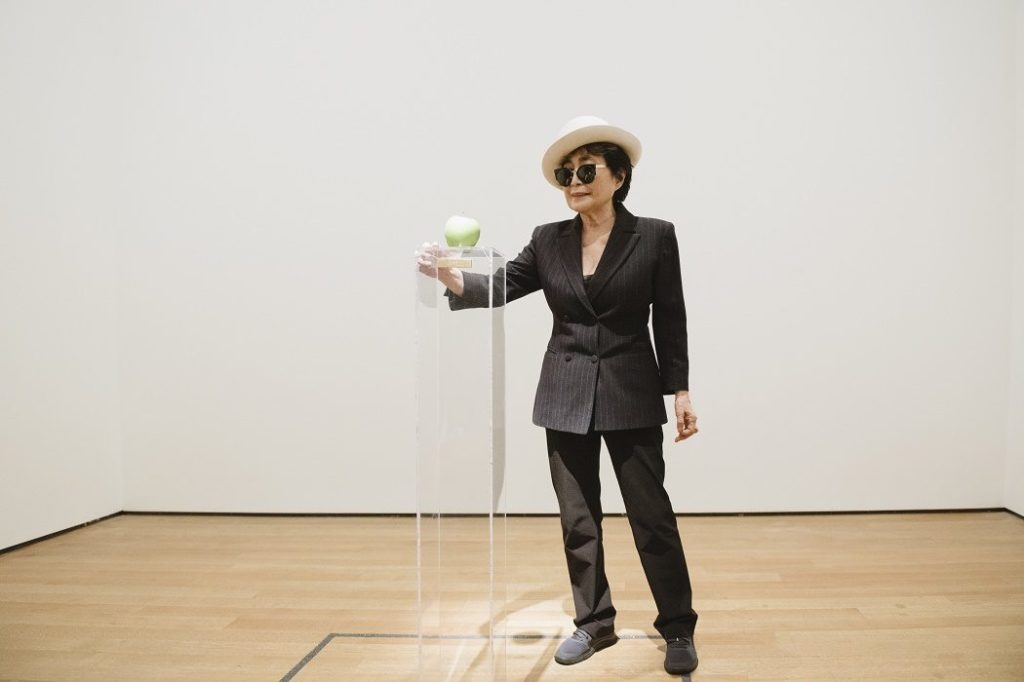
In the middle of rolling my wheelchair from one room to another, Yoko Ono suddenly entered my brain. Immediately i began to wonder when i first became familiar with her.
Similar to Winnie Mandela, Amy Jacques Garvey, Shirley Graham DuBois or Mama Zondeni Sobukwe, people continue to view Yoko Ono as an extension of her husband. Even though i’ve heard her name ever since i was a child (as anything associated with The Beatles was fairly ubiquitous in popular culture), when i came to know who she was, i was always fascinated with her.
For as long as i can remember i have been into what is considered the avant garde of music, art, poetry and film; i saw it as an extension of the punk ethos- a rejection of the status quo. When i first saw Yoko Ono’s primal screams on the Rock And Roll Circus, i saw her as the predecessor of bands such as Free Kitten and The Boredoms. ‘Give Me Something’ was the one song i had on repeat from Double Fantasy, her collaborative (final) album with John Lennon. i heard it, and it reminded me of Siouxsie & The Banshees. Approximately Infinite Universe (Ono’s third solo album) has become one of my top 50 favorite albums of all time, and with the risk of being ridiculed, will argue that i prefer Lennon’s work with Ono to any Beatles album (then again, i am a person who openly considers St. Anger to be one of the top 10 greatest of all time, so my musical preferences should be of little to no surprise).
Make no mistake- Ono has her share of contradictions. This is not the primary aim of the discussion. Among other things, even with the heavily problematic utilization of a racial epithet as an analogous address toward the damaging effects of patriarchy (from the album Sometime In New York City), her grievances are not incorrect.
i saw Ono in the late 1990s at an early film retrospective she hosted at the Whitney Museum. During the question and answer period, you could see her increasing frustration with the questions and comments which downplayed her artistic integrity. The moment that will forever be sealed in my brain was when a man stood up and began to name drop a series of (male) musicians who could have worked with her on the soundtrack to one of her films. Steely eyed, she responded, “That was all me.” Embarrassed, the man slowly sat back in the chair.
i walked out of the museum with a greater respect for Yoko Ono, as a woman working outside the parameters of gendered and artistic expectation.
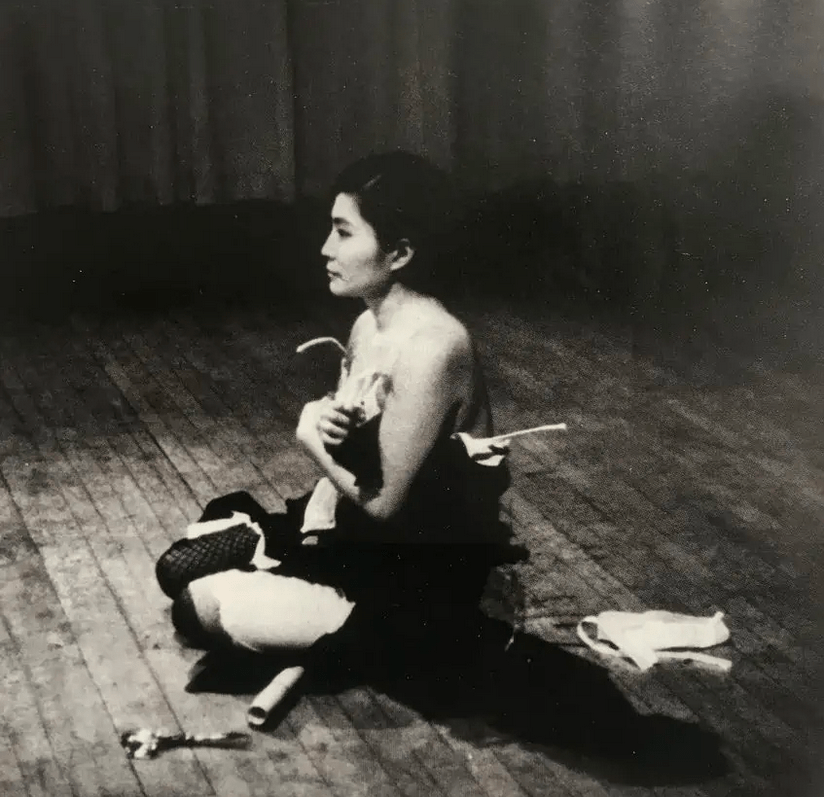
Cut Piece (Rob Corder, CC)
“In Fluxus there has never been any attempt to agree on aims or methods; individuals with something unnameable in common have simply coalesced to publish and perform their work. Perhaps this common thing is a feeling that the bounds of art are much wider than they have conventionally seemed, or that art and certain long established bounds are no longer very useful.”
-George Brecht
“Force and intimidation were in the air. People were silenced. Cut Piece is my hope for world peace. When I first performed this work, in 1964, I did it with some anger and turbulence in my heart.
This time I do it with love for you, for me, and for the world.”
-Yoko Ono, 2003
The message lined within the gatefold of 1973’s Approximately Infinite Universe makes a pertinent defense against ‘Girlboss’ feminism, ultimately rooted in patriarchy and capitalism: “The aim of the feminist movement should not just end with getting more jobs in the existing society, though we should definitely work on that as well. We have to keep on going until the whole of the female race is freed.
How are we going to go about this? This society is the very society which killed female freedom: the society which was built on female slavery. If we try to achieve our freedom within the framework of the existing social set-up, men, who run the society, will continue to make a token gesture of giving us a place in their world. Some of us will succeed in moving into elitist jobs kicking our sisters on the way up. Others will resort to producing babies, or be conned into thinking that joining male perversions and madness is what equality is about: “join the army” “join the sexist trip,” etc.”
Messages that address intersections of oppression in some fashion are always going be timeless, similar to art that challenges the notion of what the capitalist class considers ‘decent’ or ‘presentable’.
Within the the Fluxus movement (of which Ono was a part of) was a manifesto in which the objective was the direct opposition to the domination of commercial/bourgeois and Eurocentric notions of art. Of course, thinking about Fluxus led me to further think about Adam Neely’s commentary regarding how Western/European imperialism has shaped how many come to critique and interpret music; though Neely was critical of the systems that dictate these vehicles of education and criticism (and not necessarily the music itself), Neely’s examination in many cases was reduced to ‘wokeness’, with a focus merely on the baseline and not necessarily the content within it. Many arguments against Neely seemed to actually prove his point.
The result of the commercialization of art and music is the reduction of access to the masses. When we think of Classical/Baroque music, it’s equated to something that is ‘high class,’ when in some cases it was anything but. Several currently revered musicians left this earth in poverty, and were debated over during their time on earth. One of the greatest examples of this is Antonio Vivaldi’s Le Quattro Stagioni (translated into The Four Seasons). Composed during his time as a teacher at the Ospedale della Pietà (simultaneously encouraging girls to play music), the concerto of 12 movements was deemed ‘radical’ at the time, as this format was not common.
It would not be surprising that someone in this day and age would regard Fluxus as being synonymous as ‘high art’ or ‘high class’, since it may not currently be thought of as confrontational as was originally intended. What does remain confrontational is the existence of Yoko Ono.
Even with her contradictions as an individual, her existence in this world as an Assertive Asian Woman Artist automatically politicizes her, despite the constant lament that ‘politics should stay out of art and music.’ The greatest art is going to lead us to question our place in society, and acknowledge the intersections within it. Both Ono and fellow Fluxus artist Shigeko Kubota actively struggled against patriarchal mores (in both Japan and the U.S.) through active works such as Cut Piece and Vagina Painting.
Despite Ono being a successful artist in her own right, her legacy will forever be tied to John Lennon, who initially met her at one of her performances. Even worse, despite being countered by members of the Beatles themselves, she continues to be vilified for being the person who single-handedly ‘broke up the Beatles.’
Similar to my feelings on Metallica’s St. Anger and Lulu, or Beefheart’s Trout Mask Replica; while i have no problem with Ono’s output, i do understand why both former and latter works are polarizing. i will not argue about this. That said, when i see comments calling her everything from a “Manly looking beast… who has the face that would make a freight train take a dirt road,” to a “pesticide,” to “a verified witch,” as well as, “I’m just here wondering how fucking high Lennon was that he saw any beauty in that faulty alarm siren of a human”… right on down to “Chapman shot the wrong person,” it’s easy to see that it becomes less about art and more about racism and patriarchy.
As John Lennon openly struggled with his own experiences as one who committed violence upon women and children (the man also mocked disabled folks on camera); he continues to be lionized as his history of abuse is seemingly expunged from the vocabulary of admirers, and the same violence upon which Lennon wished to atone for is enacted upon his wife.
We live in a society starved of maturity, where we are conditioned to see everything as binary, as a dichotomy. It should be clear that accountability and addressing one’s contradictions are not synonymous with ‘cancellation,’ and yet many take offense at just that, dishing out death threats and doxxing to those who dare challenge the idealized images of a celebrity.
While it was ultimately idealistic; i do not have the definitive answer on what (or who) led John Lennon to a more philosophical trajectory, mixed with a socialist-leaning political analysis. What we do know (whether it was with Maharishi Mahesh Yogi or Yoko Ono) is that a spectrum of the cultural and spiritual Asian landscape had a hand in the latter chapter of his life’s journey. It could be possible that Lennon held a warped fetishishization of all that is ‘Asia’. Again, i do not know.
(Also) Again, what we know is that in a society based on hierarchies and imbalance; there was a resistance to the introduction of an increased feminine element in Lennon’s life journey. The more time he spent with Yoko, the more she became an ‘equal partner’ as opposed to simply, ‘a wife’. The more she developed into an ‘equal partner’, the more he was forced to question the intersections of oppression, both in society and within himself. The argued root of the opposition was not only in Yoko Ono ‘killing the Beatles’; she also emasculated John Lennon.
W Magazine recreation of ‘Cut Piece’
This may seem a strange or inappropriate comparison to some- while Yoko Ono’s actions as a whole have not resulted in materially dangerous consequences; my defense of her is not unlike those who supported an OJ Simpson acquittal in 1994. The support is not of the individual, but what they represent in a hierarchical social structure. Aside from the most dedicated of the ‘Free OJ’ contingent; the cries of joy upon news of this acquittal (particularly after the acquittal of the LAPD officers that beat Rodney King on camera in 1991) did not necessarily represent support for OJ himself. Simpson was a symbolic victory. It can be debated all day whether or not this was an apt response; but if we are quick to judge or dictate how the recipients of structural and systemic violence have responded to such an event, and if we are quick to see all responses to this acquittal as monolithic; we must question the root of our own reaction.
Among mainstream conversation was the focus on the acquittal itself. The view was pretty cut and dry: OJ was ‘one of the good ones,’ until he wasn’t. Despite his long history of abuse towards women, he was now seen as a brute; he became racialized in a society he assimilated in, because he murdered (or had a hand in murdering) a blonde, white woman- the pinnacle of femininity in a white supremacist system. Among African communities in particular, there was a more nuanced understanding that despite Simpson rejecting all connections to ‘the culture’ until it was convenient, and despite him being a traitor to the people’s class; the circus of the trial led the world to witness even further the racist tactics of the Los Angeles Police department (LAPD), and attorney Johnnie Cochran was able to exploit this. He emphasized to the jury: “If you don’t speak out, if you don’t stand up, if you don’t do what’s right, this kind of conduct will continue on forever.”
Cochran had his share of contradictions in whom he represented as a defense attorney; that said, even if those he defended have been incredibly problematic; Cochran most likely looked at his role as serving a larger purpose, particularly in light of his work defending comrades such as Geronimo Ji-Jaga Pratt.
My defense of Yoko Ono is not about Yoko Ono herself. i do not personally know her enough to defend her character as an individual. Ono (and others like her) participated in paving the way for confrontational art that holds a mirror up to society. The legacy of Ono (and her comrades in Fluxus) gave way to the marriage of art and unconventional voice, with artists such as Kate Bush, Lene Lovich, Diamanda Galás, Mike Patton (and his many projects) and Klaus Nomi. Her body of work is just as important as Albert Ayler, Sun Ra, Pharoah Sanders, The Residents, John Coltrane, Keiji Haino, Sonic Youth or John Zorn. To some degree i’m sure she has even had some subconscious influence in my own experience as a person who has participated in art/writers’ collectives, as well as the curator of house shows and makeshift ‘galleries’.
After a number of years from a break, within the past month or so i began painting again. It’s something i missed greatly, and perhaps this written piece is the universe contributing to making a connection to what i’ve already renewed in myself.
In a culture where so much is devoid of context and reduced to a meme, we must appreciate Yoko Ono beyond the perception that she is some ‘unhinged wild woman’ who wails in the middle of a museum.
This piece is ultimately not about Yoko Ono as a person, but the voice that is within each of us, constrained by the cloak of society’s limitations or hierarchical structures. Each cut we make of the cloak that covers the most vulnerable parts of ourselves, will eventually reveal the beauty that lie underneath.