
(This piece is going to have major spoilers- proceed if you are okay with that, or if you have seen the film. Thanks for reading!)
i am going to be honest.
The only film i have seen directed by Ryan Coogler was Black Panther, also the one and only output from the ‘Marvel Cinematic Universe’ canon i have ever seen. i loudly booed this film in the theater as the credits rolled. Not only was it incredibly counter-revolutionary in its depiction of the CIA- an historical and present enemy of Africans at home and abroad- seen as beneficial to the continued existence of this fictional land of Wakanda; any characters that displayed revolutionary self-defense were seen as megalomaniacal, or enemies of the people. In comparison, respectability politics were depicted as virtuous. Wakanda also cut itself off from the rest of the African world, as opposed to distributing its vast resources. People have described the film as Pan-Africanist. However, the actual plotline belies the feel-good symbolism, as the isolationism of Wakanda did not contribute in any way to the unification of the African world against colonialism or imperialism.
It was nothing but a high budget popcorn superhero movie. With that, i did not not have the highest expectation for Sinners, once aware that it was directed by Coogler.
i saw the trailer for Sinners a couple of times in the theater, among the 20 minutes of trailers before the actual horror feature i came to see. It’s very rare that i have interest in seeing anything released by any of the three primary major studios at this point in my life, and besides One Of Them Days (which i saw randomly and not on purpose- i enjoyed the slight ‘body horror’ elements of the film), i cannot remember the last time i actively went out to see one upon its release.
Admittedly, despite the lack of expectation (given the director), and without awareness of the plot’s description, my interest was slightly piqued after seeing that the film had horror elements. The other thing that piqued my interest was hearing about Coogler being inspired by Metallica’s ‘One’. It also helped that Lars Ulrich (my biggest musical inspiration) participated in some of the music on the film’s soundtrack. Having read that, i imagined that would influence any perceptions or assumptions. However, after watching the film i could not be more pleased that any initial perceptions or assumptions i had were absolutely incorrect.

Upon watching the trailer twice, i assumed it was a zombie/possession movie of sorts. Having seen two other trailers post-watch; i realize the trailer released in the theater was a bit different, as it emphasized the horror elements (with not as many talk-overs), simultaneously giving nothing away- because i had no idea this was a vampire movie.
The first impression i get is that it was inspired by a combination of horror and cult classics, from Invasion of the Body Snatchers and Get Out (for obvious reasons) to The Lost Boys (with the vampires forming an alternate community (or ‘family’) of misfits to the mortal world); to The Stuff (with the characters acting strange but simultaneously familiar post takeover), all the way to fellow Warner Brothers alumni The Color Purple (where it’s real easy to make slight parallels between not only the two juke joints, but also between Shug Avery and Sammie Moore).
On ‘One”s inspiration, Coogler said he “wanted the movie to feel like a song”… It “starts off intense, then gets melodic and going somewhere just fucking crazy. But by the time you’re finished, it was clear you were always going to get there.” In the middle of watching i attempted to make sense of Coogler’s vision, based on this inspiration.
And then it hit me.
A very cursory connection to this inspiration is that both the film and song introduce us to the respective characters- both having gone through incredibly traumatic experiences, almost losing their lives, suspended through two different worlds. But of course, i am that person who thinks a bit deeper about things. Both pieces of art introduce us to a set-up, which takes us to the eventual crux of the characters’ conditions. The two verses of ‘One’ are not unlike the first half of Sinners, where we are introduced to the primary characters. The unnamed soldier in ‘One’ (or perhaps it is actually Johnny Got his Gun‘s Joe Bonham, the character ‘One’ is inspired by) finally describing the root cause of what happened to him can be compared to the final half of the film, where we are introduced to the vampires- the ‘military industrial complex’ of the film, a force which promotes freedom and unity among difference, but ultimately wages destruction, physical and mental harm, and separates families and loved ones.
One of the most crucial scenes in the film is where the vampire hunters of the Choctaw peoples attempted to heed a warning, and upon being pushed away their response was essentially, “We will pray for you,” as they rushed off before sundown. However, the intent was, ‘As a result of your stubbornness, you will experience pain like no other.’ This conjures up the scene in the film adaptation of Johnny Got His Gun, where the priest tells the generals, “He is the product of your profession, not mine,” after being asked if he had a message, or words of encouragement for Bonham, who is furiously bobbing his head in Morse code as his only means of effective communication.
While the connection to ‘One’ may not be obvious to those not familiar with either Coogler or the song, Sinners definitely was set up to be a love letter to the roots of African music (and its progenitors).
While i tend to be less of a fan of non-diagetic elements in film- that is, sounds or music that are not part of the natural landscape of the film- massive examples being the works of Martin Scorsese, Quentin Tarantino or Wes Anderson; Sinners did an excellent job of fusing the diagetic and non-diagetic. While someone playing a guitar, harmonica or piano in a scene is clearly based on diagetic elements; any music added in post-production felt just as crucial to the plot, versus, for example, playing a Rolling Stones song in a fight or chase scene… or even more specifically, adding more modern songs in a period piece. This is one of the rare cases i’ve seen non-diagetic uses of music be as effective a character as any human.
Sinners took extra care (outside much of the credits) to be as authentic as possible regarding its choices, going so far as to hire language, music and cultural consultants. It’s also important to note that Miles Caton, who played Sammie Moore), learned to play guitar for his role, as opposed to hiring a professional guitarist, thus dubbing them in. One of the most compelling moments of great use of the mix of diagetic and non-diagetic is when composer Ludwig Göransson (who has worked with Coogler on several films) fuses the connectivity of the past and present state of African music and other cultural contributions, from the drums of the griot, to the blues, to hip hop, Afrofuturist rock, and more.
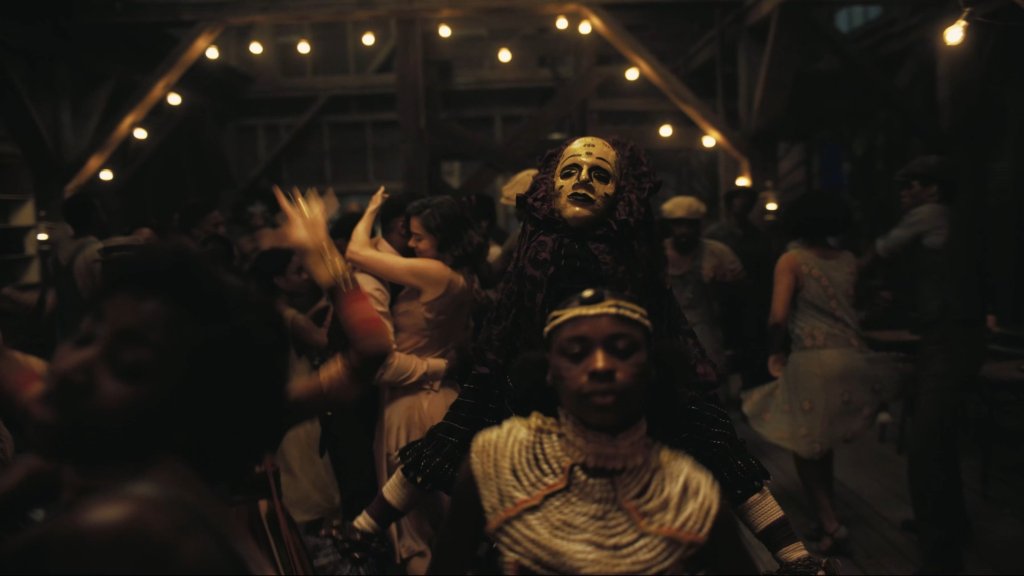
Another crucial scene was the ‘Rocky Road To Dublin’ sequence- a scene which had me dancing pretty hard- where the vampires had a ritual dance before the major attack on the remaining juke joint members. In the midst of this sequence; in the midst of aiming to convince the remaining juke joint members- Sammie in particular- to come with the vampires, Remmick (played by Jack O’Connell) says, “I am your way out. This world already left you for dead. Won’t let you build. Won’t let you fellowship. We will do just that. Together. Forever.” i believe it was Remmick who also talked about the land of his people being stolen, thus settling elsewhere.
This scene gives me another perspective, contradicting my previous one about the vampires being comparable to the military industrial complex- though i still think that is a valid perspective. While the costumes and references to the triple K will lend to some familiarity to the majority of filmgoers (particularly those who live in the U.S.); i think the larger framework of the narrative is anti-colonial, and anti-appropriation. While we see Remmick as the initial bringer of the mayhem in the film, i do question if he is the head vampire, as he appears to mostly be an agent or vessel. We (or at least I) ultimately never see (what i imagine to be) the the head vampire (or force) which was the root of the mayhem. The majority of the people whose energy was a target for the vampires to siphen from were colonized, either in the past or presently; whether they be from China, Ireland or Africa. The (indigenous) Choctaw peoples’ warning about the physical manifestation of this force went unheeded, and destruction ensued.
Alongside this interpretation, the depiction of the vampires could also be a manifestation of capitalism. Many of the characters in the film were sharecroppers, never having full ‘ownership’ of the land, and fulfilling quotas in order to access a bit of land and resources. For some, sharecropping (which was still on the spectrum of labor exploitation/wage theft) was a means of a modicum of ‘moving up’ from the ravages of enslavement.
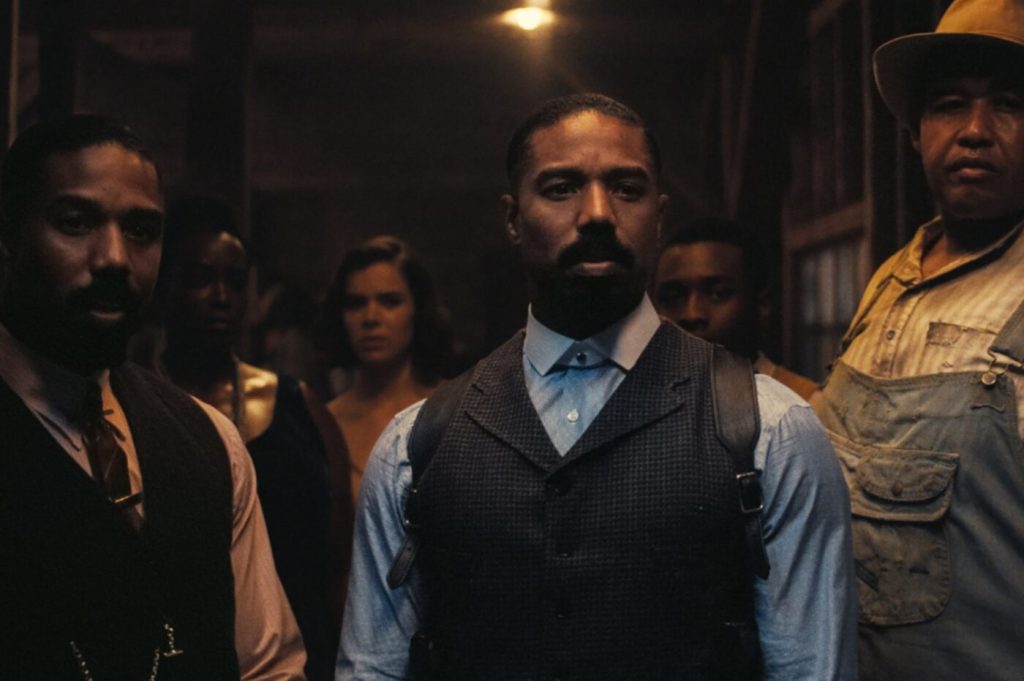
Twins Smoke and Stack (both played by Michael B. Jordan) escaped sharecropping to hustle in Chicago, but decided to return to the place they escaped, either by preemptive measures, or by force. A message ultimately learned by the brothers (or what was left of them) was that under capitalism, any promises made by those who control the means of production can also be reneged at any moment. A dream of opening the ‘safe space’ of a juke joint in a place (superficially) deemed safe from Klan presence can never be reality in an environment rooted anywhere in which the very foundation is white supremacist. While we concentrate our focus on particular individuals as the primary villains (such as the ‘on the nose’ racists), it becomes easier to lose site of the invisible hand of the system which enables these individuals to exist and thrive.

Another reason i tend to avoid films produced/released by major Hollywood studios is the reliance on the formulation of caricatures which adhere to protagonist/antagonist tropes. There are far too many cartoonish depictions of racists (from the southern part of the U.S. in particular), as either uneducated, ignorant and oafish, or outright sociopathic; deliberately extracting the system itself as the ultimate villain. Due to its clear allegorical methods, Sinners successfully escapes this trope, despite it being set primarily in the 1930s. No one character is seen as inherently good or bad, and even the bulk of the so-called ‘antagonists’ are read sympathetically in some capacity.
The system identifies itself to the masses as attractive, by reading as all-inclusive- ‘You too can achieve the (white) American Dream, if you work hard enough, or act accordingly.’:“I am your way out. This world already left you for dead. Won’t let you build. Won’t let you fellowship. We will do just that. Together. Forever.” However, by depicting both the colonized as well as the descendants of colonizers/racists who did not heed the warning of the vampire hunters (for example) as being ‘sucked up’ by vampirism, Sinners shows that the vampiric system of capitalism is no respecter of ethnicity, class or gender, if none of those people control the means of production.
It would not be that difficult on its surface to interpret this film as giving the narrative that ‘White people are devils.’ As a matter of fact, i can guarantee that there are at least five people within five miles of whomever is reading this piece who feel that way. If we remember that capitalism is no respecter of race or gender, then it should be understood that any ‘white devil’ interpretation with no analysis is a reactionary interpretation of this film; it’s also an incredibly simplistic and myopic one.
Another trope that was handled fairly successfully, in light of what i see as the allegorical framework of the film, was the combination of the (fortunately no longer utilized as a common phrase) ‘tragic mulatto’, with the ‘white interloper’. A poorer film would have utilized Mary (played by Hailee Steinfeld) as a distraction, via the singular vehicle of a mere interracial love interest. However, Mary’s character arc, while indeed Stack’s love interest, read more as an exploration of the insidious nature of capitalism. On its surface, Mary’s existence could be read as a dichotomy between the ‘class collaborator’ and the ‘chosen family’. Mary initially approached the (not yet known as) vampires, utilizing her ability to ‘pass’ as a way of protecting her ‘chosen family’, but ultimately became an unwitting victim. While it is mentioned that her father was “one quarter Black,” in displaying the promises of wealth (and the lure of unrestricted desire), the vampire version of Mary lends herself as a vessel to evoking what would eventually become known as the ‘Black Misleadership Class.’
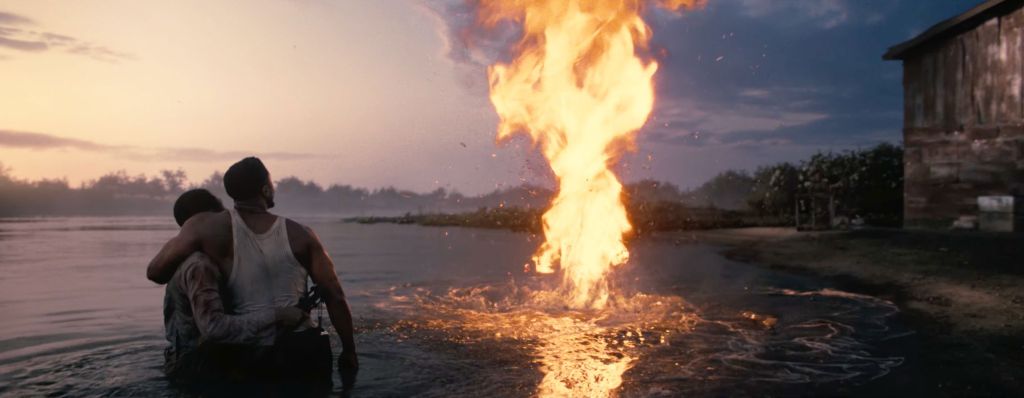
It should be obvious at this point that any interpretation i have of this film as a critique of capitalism is from a class analysis (of which race and ethnicity are factors); however, the cultural critique of capitalism is just as prominent.
Going back to the ‘spiritual resolution’ in the final act of The Color Purple, in a scene that consistently moves me to tears, Shug Avery felt compelled to return in some fashion to the church her father oversees. As she embraces her father, Shug (played by Margaret Avery) says, “See daddy? Sinners have soul too.” This is followed by a shot of a massively subtle, blink and you miss it smile by Celie (played by Whoopi Goldberg), who, with a lot of work and coordination reunited with her own sister, after decades of forced separation.
Despite being separated from his father Jedidiah (played by Saul Williams) for only one day, the trauma Sammie faced encouraged him to make a life-altering decision. As a Preacher’s Kid (or PK), despite the love he had for his father; he did not feel the same calling of the Protestant church as Shug Avery did. ‘Sinners’ indeed still had soul, but it was connected more to music itself as a journey, guided by ancestral memory and traditional spirituality, not tainted by colonial interpretations of God, enforced onto enslaved Africans.
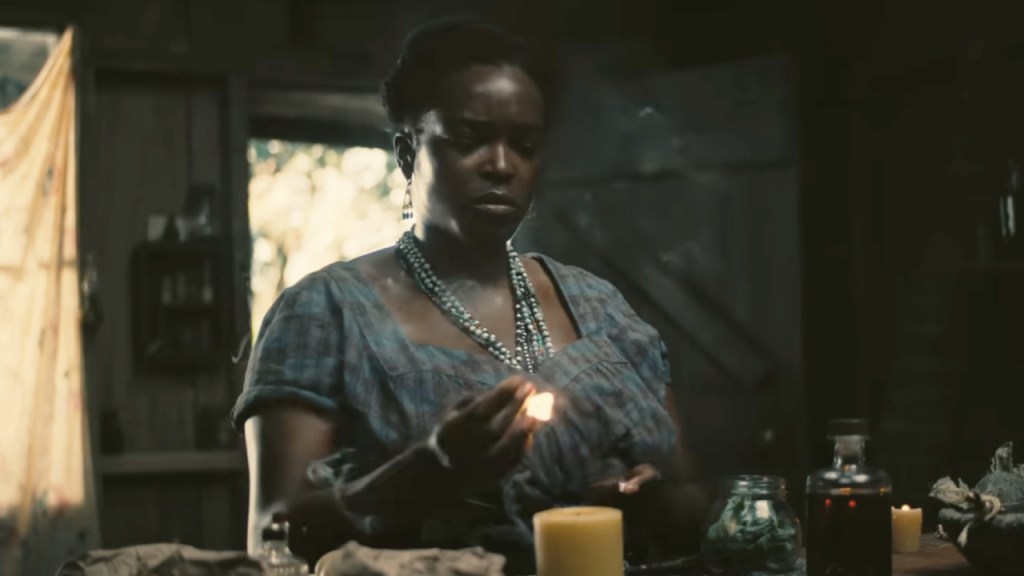
The practice of Hoodoo was as pivotal a character as music was in the film. Practitioner Annie (played by Wunmi Mosaku) could have also been written as a caricature, depicting her as an older and undesirable (in the eyes of Hollywood and mainstream society) wise sage. But while there was spiritual certainty in her life, there were simultaneous tangible unknowns, such as the unresolved death of a newborn.
The women in the film were amazing. Women in many cases were the primary negotiators, the men often deferring to them. There is also a scene where a teenage girl is being encouraged to negotiate for what she wants, as opposed to settling. One of my favorite scenes in the film is in the first act- a negotiation scene with Grace (played by Li Jun Li). There was also a wonderful long shot of a brief exchange between Grace and her stoic daughter Lisa (played by Helena Hu).
Women were on the front lines of battle against the vampires, which is not unlike women (and many other marginalized folks) being on the front lines against state-sanctioned terror and other vestiges of capitalist violence. Women were not only the vehicle for men’s pleasure, but a willing participant in their own. i don’t necessarily see Coogler’s vision for the film as primarily a feminist one- at least not in the ways ‘feminism’ tends to be envisioned under capitalism. While patriarchy is a stark reality (as we wither live under capitalism, or among its remains), i see how the women of Sinners (and people in general) are depicted as being a reflection of a society not enveloped by the gender wars prominently displayed on the internet in our modern times, and assumed to be universally agreed upon. The women were as fleshed out as full humans (as much as one could be in a movie about vampires), as not only were they a source of strength and might for the community, but also displayed a great deal of vulnerability and care.
The women of Sinners could as well have been Carlotta Lucumi, Queen Nanny, Fannie Lou Hamer or Mbuya Nahanda.

i’m glad i saw the trailer i did in the theater. While the film was greenlit by one of the three largest studios in Hollywood, it didn’t necessarily feel like a big budget film. While the two trailers i saw after seeing it actually did give it ‘big budget Hollywood’ energy; Sinners would not feel out of place if it were to be released by a, say, A24 or Neon. While there was obvious CGI/digital work (Michael B. Jordan playing twins, sitting in the same car with each other for starters); this was the most obvious link to the budget, as the technology has gotten so advanced, that even much of the CGI has begun to look like practical effects.
This was also a film which was a clear resistance to the commodification of film as mere ‘content’. Yes, even with any views i have regarding this film’s potential for an anticapitalist analysis; it’s still a popcorn movie. That said, with one fairly long mid-credits scene, and one post-credit scene, this is seemingly Coogler’s response to the Netflix-ification of cinema (though it has happened prior to the company’s almost ubiquitous existence), where the moment the credits roll, people leave or switch to something else.
In the spirit of the honoring of elders, blues guitarist Buddy Guy (who i took my mother to see in concert back in the 90s) was featured heavily in the mid-credits scene, as Sammie, now 60 years older and wiser. With so many of our elders leaving this earth, it was a pleasure to see this scene.
In an interesting turn of events (and in a scene that, while i enjoyed it, i’m afraid may have been written to establish a series of sequels (or a universe, as opposed to a film that stands on its own)), Stack and Mary returned (in newly-formed bodies) to pay Sammie one last visit. Despite everything that occurred- the deaths and the lifelong effects of trauma- both Sammie and Stack mutually concurred that the night everything went down was one of the most freeing experiences they’ve ever had.
Miles Caton, in the final post-credit scene, sits down to perform the well-known gospel standard ‘This Little Light Of Mine’ on vocals and guitar, i saw this scene as Caton simply showing his talents, as opposed to him embodying the role of Sammie one last time. In a true ‘blink and you will miss it’ moment (which life partner jesse did miss, because he looked down at his phone for one brief second), before the screen goes black, Caton lifts his head, and his pupils appeared to be a similar color to the vampires, after they were initiated. This is either a well-played fakeout, or again, something which gives me a feeling of the potentiality of a sequel, or the creation of a universe.
We can only hope for the best… But we all know this is Hollywood.
____________________________________________________________________________
There’s much to the film i did not address (such as the color schemes and wardrobe choices), and i’m sure there’s plenty i’ve missed even in what i’ve written; there’s a lot to mull over, and this piece is simply a discussion of my initial thoughts. i purposefully chose not to look up any reviews or interpretations of this film prior to writing my own so as to not influence how or what i would write; so admittedly, any of my views could also be entirely off.
i definitely do not take back what i’ve said about Black Panther; Coogler does show that he can be a creative writer, when not necessarily constrained by the expectations of Hollywood’s notions of ‘Blackness’.

(All images courtesy of Warner Bros.)

 the one woman apollo!