(Note: This post discusses abuse, suicide, rape and mental health struggles)

The day after learning of the passing of Shuhada’ Sadaqat (also named Magda Davitt, but best known as Sinéad O’Connor), i had a mental health breakdown of inescapable intrusive thoughts, where i made the difficult decision to (once again) phone the suicide hotline. It is one of the most difficult decisions one can make.
Today, as i prepared to write this, i learned that Shuhada’ Sadaqat made the decision to reach out to others several times over the years, through means of a video on social media:
“I am now living in a Travelodge motel in the arse end of New Jersey… I’m all by myself. And there’s absolutely nobody in my life except my doctor, my psychiatrist – the sweetest man on earth, who says I’m his hero – and that’s about the only [expletive] thing keeping me alive at the moment… and that’s kind of pathetic. I want everyone to know what it’s like, that’s why I’m making this video. Mental illness, it’s like drugs, it doesn’t give a [expletive] who you are, and equally what’s worse, it’s the stigma, it doesn’t give a [expletive] who you are. Suddenly all the people who are supposed to be loving you and taking care of you are treating you like [expletive]. It’s like a witch hunt.”
People who do not experience ideation or intrusive thoughts… or if they’ve never made attempts may suggest that seeing a therapist will be a move towards a solution. A therapist can be a wonderful tool for maintenance; what those who suggest therapy tend to miss is that humans still need connection; humans still need community. A therapist is but one person; nor are they your friend, if they are doing their job correctly. We should never depend on a singular person to contribute to our survival. It’s unhealthy for both that person, and ourselves.
“Strangers like me.. But my family don’t value me at all. They wouldn’t know if I was dead until weeks from now if I wasn’t [expletive] informing them now.”
Those of us who have lived on the margins end up choosing our families, if we survive this cruel world. Sometimes when i am experiencing an extremely low point i compliment strangers to help myself to feel better. i do not expect a compliment in return- it just feels better to see someone else smile, when i cannot. i built friendly relationships with hospital workers, when my own mother did not visit me in the hospital. i still have yet to see her. My first interaction with her since becoming an amputee was being yelled at over the phone while laying in the hospital bed, because she was not among the first to know.
Hopefully sister Shuhada’ has finally found peace with her eternal family.

This is not something i’ve spoken about a lot, but Sinéad O’Connor was one of the handful of women who greatly inspired me: Grace Jones, Skin (from Skunk Anansie), and Leslie Rankine (of Silverfish/Pigface/Ruby) were among this short list of women, who defied notions of gendered expectations, and ‘traditional femininity’; these were women with shaved heads and tattoos, and from my shy vantage point didn’t have any problems asserting themselves. Rankine, in the documentary Not Bad For A Girl states, “A lot of men cannot relate to women at all. The only way they know how to relate to women is through sex and control. And if they can’t control us, then they try and kill us.” She continues by discussing the importance of the the balance between masculine and feminine elements, and that the imbalance occurs “when people aren’t in touch with their other side,” and that “(t)he natural male-female relationship has been so screwed up by social conditioning.”
Though the documentary was released in 1995, Rankine’s words still hold true, especially in light of the very clear rise of ‘manosphere’ culture and right wing anti-queer and gendered violence (merged with way more than a tinge of racism), whether physical or through policy (which you can see here, here, here and here). Her words also hold true because anti-trans legislation is not simply an updated version of the Lavender Scare (in which the ultimate objective is based in anticommunism); it is a means to control women’s existence. This concern in regards to children holds no weight, when much beloved institutions have notoriously supported the grooming and assault of and on children for decades.

You must have known this was coming.
i remember the moment vividly, as i watched it happen live. It was the 3rd of October in 1992. i was about to be 16 years old. It was the moment that was inspiring- not only to me, but to many.
Sinéad O’Connor ripped up a photo of the pope (John Paul II), during a performance on the show Saturday Night Live. In the midst of completing her cover of Bob Marley & The Wailers’ ‘War’ (which was in itself inspired by a Haile Selassie speech); as she sings the word ‘evil‘ with much derision, she presents a picture of said pope, then proceeds to rip it in half. She rounds everything out with a statement to “Fight the real enemy.” She then takes out the in-ear monitors, blows out the candles next to her, then walks off. You could hear a feather drop in that studio. This was a mission. This was a prayer. This was standing in solidarity with anyone who had been abused as a child, and children who were currently being abused.
She publicly stood alone. She was demonized.
People currently use the word ‘cancelled’ in a cavalier way, as they appear on television, and/or get paid millions of dollars on a tour to lament about ‘wokeness’ and ‘not being able to speak freely.’ In a moment that is now being seen as brave, Sinéad O’Connor (and those like her) had her life altered by being banned, because she made the decision to address institutional child abuse. She was satirized and attacked (by people like Madonna and Joe Pesci).
Immediately after the performance, she was interviewed by a host on what i think was a public access show, covering the reggae scene. i cannot be certain, but even as she did cover the Wailers at the time, i do wonder if her being embraced by this community of people led her to a connection to eventually embrace Rasta as a spiritual practice in the early to mid 2000s (which, interestingly, i have not seen mentioned in many places eulogizing her).
Leslie Rankine (in the same documentary) has also observed religion to be used as a means of social control. While sister Shuhada’ did leave this earth a Muslim, she was on a constant search for spiritual solace and guidance. Regardless of what she practiced throughout her life, she still questioned what was before her. In the midst of her constant critiques of the Vatican, of religion in general she stated in 2013, “…all religions, but certainly the Catholic Church, is really a house built on sand, and it’s drowning in a sea of conditional love, and therefore it can’t survive, and actually the office of Pope itself is an anti-Christian office, the idea that Christ needs a representative is laughable and blasphemous at the same time, therefore it is a house built on sand, and we need to rescue God from religion, all religions, they’ve become a smokescreen that distracts people from the fact that there is a holy spirit, and when you study the Gospels you see the Christ character came to tell us that we only need to talk directly to God, we never needed Religion…”
Her relationship with Rasta, her being ordained by the of the Irish Orthodox Catholic and Apostolic Church, and her last days as a Muslim all symbolize her seeking out a relationship with God wherever she could find it. She did not seem to hold as strong an interest in the label.
Her path to seek a relationship with God in many ways matched her advocacy against institutional, political and social injustices. It is not a rare occurrence for people who hold the most stringent principles against injustice to be ridiculed, critiqued or attacked. People in the u.s. who choose not to vote either democrat or republican (as both parties hold the same capitalist, imperialist, anti-African value systems) are always given the ‘Our ancestors died for the right to vote’ gaslight-based rationalization. When asking most people if they are doing any level of organizing (or at the very least, activism) to assure they are ensuring the type of world they want to see, the answer tends to be no. People continue to put hope in a system that is purposefully meant to not be beneficial to the masses of people, then they get upset when the candidate they vote for ‘fails’ them. In 2016, there are people i spoke with who were surprised by what seemed to be an upsurge of right wing organizing. As a long-time organizer, i saw this level of organized recruitment happening, long before 2016. As the so-called left were infighting, the right became even more organized/galvanized, utilizing the infighting to their advantage.
In the words of the great Minor Threat song ‘In My Eyes’: You tell me that I make no difference/
At least I’m fuckin’ trying/What the fuck have you done?

What happened to sister Sinéad is still happening. Principled people are still being asked to make statements not more plain, but more palatable, so as to not test the waters…. so as not to lose jobs or sponsorships. White supremacist/patriarchal/capitalist society is just as, if not more pronounced in this day and age; to not take a principled, strengthened position on this makes absolutely no sense. If we cannot make pronounced allegiances against these inhumane forces without consequence, this should let us know who is in control of the narrative. Remember the words sister Sinéad once sang: If they hated me they will hate you. As much as you refuse to be involved in controversy (despite the fact that a hatred for injustice should not be controversial); no matter how hard you try to stay out of ‘political issues’, you will be affected by them, whether directly or indirectly. Because everything is political. Those who control the system and the means of production do not care about you. They hate you, because they hate humanity.
If you do not speak up in the face of injustice, your silence is quite audible.
These are dangerous days
To say what you feel is to dig your own grave
The days become increasingly dangerous (especially for those who do openly and principally speak and act against it), because those who say they despise injustice are not unified to act against it. Capitalism ensures that we are too tired from our jobs, or mental health and physical health struggles to speak and act. Capitalism leads us to think that acting must be a lofty task, despite the fact that it takes community to do all things in order to work, from the minimal to the ginormous. The idea that work against injustice must be large does not account for the range of experiences and disabilities- because capitalism’s purpose is to ensure the population is fit only to have its labor exploited. Those with disabilities do not count under capitalism, and the conversations around activism and organizing don’t necessarily take disabilities into account either.
Remember what I told you:
If you were of the world they would love you
The world did not love sister Shuhada’. The world resented sister Sinéad.
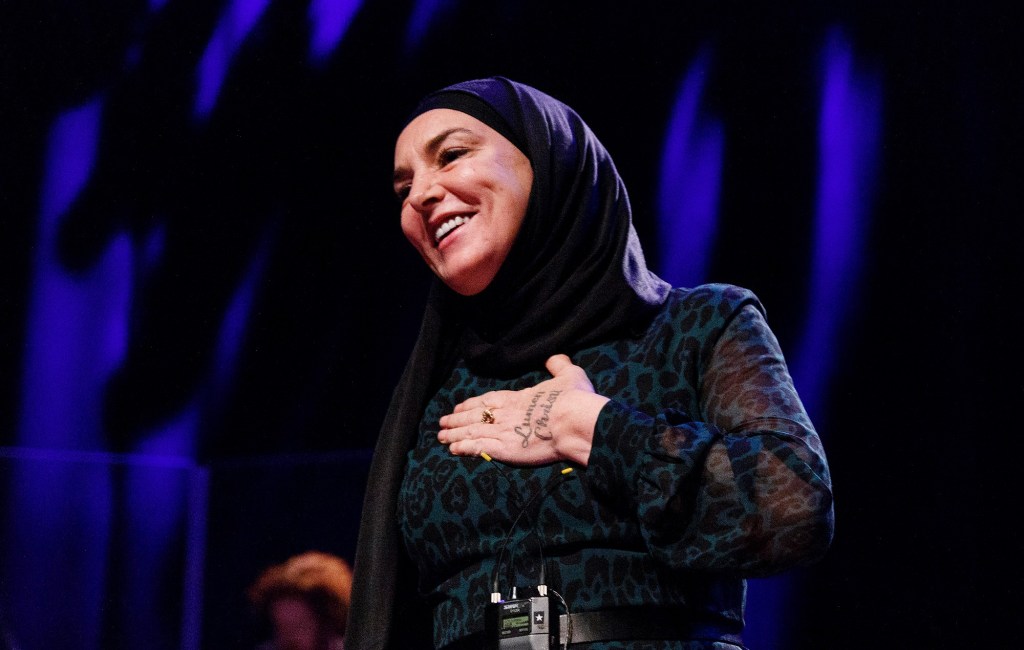
Those deep eyes full of despair, were also full of hope.
In order to be confident in your fight, you must share some sort of optimism. Sister Shuhada’/Sister Sinéad consistently protested, out of respect and love for humanity.
There are countless examples of her resistance to larger structures: In 1991 she protested the Grammys, via a letter. She noted that the purpose of the Grammys was to honor and uplift music that has produced significant profit numbers for the industry, and ignores artists who take artistic risks, or present messages of resistance. About the letter, she stated, “They respect mostly material gain, since that is the main reason for their existence. And they have created a great respect among artists for material gain — by honoring us and exalting us when we achieve it, ignoring for the most part those of us who have not.” Also: “How can we communicate with and help the human race, when we have allowed ourselves to be taken out of the world and placed above it?”
She held a policy when touring the u.s. that ‘The Star-Spangled Banner’ not be played before any shows she did. In 1990 (two years before the infamous ‘pope’ incident) she stated, “I sincerely harbor no disrespect for America or Americans, but I have a policy of not having any national anthems played before my concerts in any country, including my own, because they have nothing to do with music in general… There is a disturbing trend towards censorship of music and art in this country and people should be alarmed over that far more than my actions…”
As a result, of course, her music was banned at certain certain radio stations on the east coast of the u.s.
In February of 1992 she participated in a march and rally in Dublin, Ireland, in protest of a court decision which prevented a 14-year old girl who had been raped from traveling to England to terminate a pregnancy. As a result of the rape and pregnancy, the young girl desired to end her own life. In a speech held after the march, she states, “If you’re going to admit that a girl who has been raped should be allowed to leave the country for having an abortion, then why not come right out and admit that she should be allowed to have it here?”
In the latter part of her life sister Magda (a name she chose as a means to “free (herself) of the patriarchal slave names”) donated clothes and makeup to folks in the trans community in Ireland.
But like everything in life, sister Shuhada’s relationship with the world was dialectical. Sister Sinéad lived with many contradictions. Under a system guided by capitalism, mental health struggles are not viewed humanely. People with mental health struggles are seen as a burden because again, the point of a ‘healthy’ human under this society is to be well enough to be exploited.
With this, i think of her well-publicized exchanges with Miley Cyrus. Whether or not one agrees with her messages, the intent was to warn about the exploitative nature of the music industry: “You will obscure your talent by allowing yourself to be pimped.” Instead of principally struggling with this concern, Cyrus’ response was this (still available on Twitter as of this writing) post:”Before there was Amanda Bynes, there was…” Cyrus then proceeded to re-post comments made by Sinéad, at a time when she was open about struggling with her mental health. Sinéad’s response, in turn was:
The type of media bullying which resulted from what you did causes suicides. And perpetuates the idea that those deemed by the media to be crazy are fit for nothing but to be mocked and insulted. This causes deaths. Period.
As a result of what you did I have had numerous communications from people urging me to commit suicide. Not to mention I have been the subject of literally thousands of abusive articles and or comments left after articles, which state that I and therefore all perceived mentally ill people, should be bullied and be invalidated.
She states that had it not been for the existence of her four children (one of whom ended his life in 2022), “these types of communications and these types of articles and remarks could have had their desired effect.” She continues:
…(W)hat you did to myself and Amanda encouraged enormous abuse of us both, publicly and privately. And will certainly have made it difficult for young people who admire you and who may be suffering with mental health problems or suicidal ideation to feel they can be open and seek help, since you had us mocked for seeking help.
People of your own age in particular are vulnerable the world over. It is therefore KEY that you apologise for stigmatising mental illness and in particular for stigmatising those who are brave enough to seek help. It would be much more helpful for you to encourage young people to seek help and not be ashamed or afraid to do so.
That way, if you yourself are ever pushed to the brink of wanting to die because of show business’ effects upon you, you will be less likely to be the subject of the type of lynchings you’ve seen Britney and Amanda have to deal with, or which school kids the world over are dealing with every day.
i have not seen word of Miley Cyrus apologizing for her comments. It is possible that she eventually did. i really do hope so.
Miley Cyrus. Her musical career was able to experience several reinventions: from a young ‘Disney Kid’ to an adult pop star (who appropriated a certain perceived notion of ‘Black culture’ in order to disassociate from any ‘whitebread’ Disney associations); to a ‘legitimate’ adult country and rock artist (who of course, in turn ultimately returned to ‘whiteness’, disassociating from perceived notions of ‘Blackness’ in order to be taken seriously). Sister Sinéad never received the type of forgiveness that Miley Cyrus received. With the ‘Free Britney Spears’ movement (and the battle over conservatorship); and even with whatever struggles Miley Cyrus has experienced herself, it’s not difficult to see that sister Shuhada’ was very perceptive.

i will briefly address her struggles with Prince Rogers Nelson here, as this possibly fits under her contradictions. It’s also one of the most publicized struggles she’s had over the course of the latter part of her life. Over the years she’d mentioned that their relationship was antagonistic (given that he was (allegedly at some points) not particularly fond of her cover of ‘Nothing Compares 2U’- though (also allegedly) not opposed to the publishing money received from it). As far back as 2014 (and as late as 2021) though, she has stated that whatever relations she’d had with him had been physically violent.
i do not know if the allegations of them having a “punch-up”, or him stalking or hitting her with a hard item in a pillowcase are true; i do not know if the allegations are due to her having an episode as a result of her diagnosed bipolar or borderline personality disorder. i do wish Prince were here to respond to the allegations.
Again, everything is dialectical. While supporters, admirers, loved ones and ‘family’ (aka fans) of Prince should hold Sinéad accountable if indeed the allegations are proven to be false (as no one should be immune from critique and accountability); and while it is these same folks’ prerogative to not like her as an artist… Any attacks on her mental health are unwarranted. Any perception of Prince as wholly perfect is also unwarranted. No one (including Mr. Nelson) is perfect.
While Prince certainly did have songs protesting wars rooted in imperialism and racism (and was even on a similar spiritual journey), his objective as an artist was not to make ‘protest music’. While he had topical songs such as ‘1999’, ‘Ronnie Talk To Russia’ or ‘America’ in his repertoire; like Michael Jackson, he initially disassociated himself from any decisive political message. It wasn’t until songs like ‘Avalanche’ and ‘Family Name’ (during the post-Warner Brothers period) where the political messages were less vague, and less apt to individually interpret.
Prince Rogers Nelson always openly respected uncompromising artists, as he was also an uncompromising artist. Whatever her contradictions were, it would not be harmful to respect her for standing firm in her belief that artists should stand for something. i have seen too many artists (usually male, who have had a history of racist and/or misogynist behavior) who tend to have that behavior rationalized/excused, based on an apology with no continual redemptive action.
in her letter to the Grammys, she writes: “Thousands of children are starving to death every day…children are being beaten up because of problems in society… children are being sexually abused and emotionally abused, people are living in the streets… It’s not enough any more to just sit in you[r] chair and say, ‘Yeah, it’s terrible.’ Musicians are in a position to help heal this sickness, but I’d say 90% of the artists in the music business fail in that responsibility.”
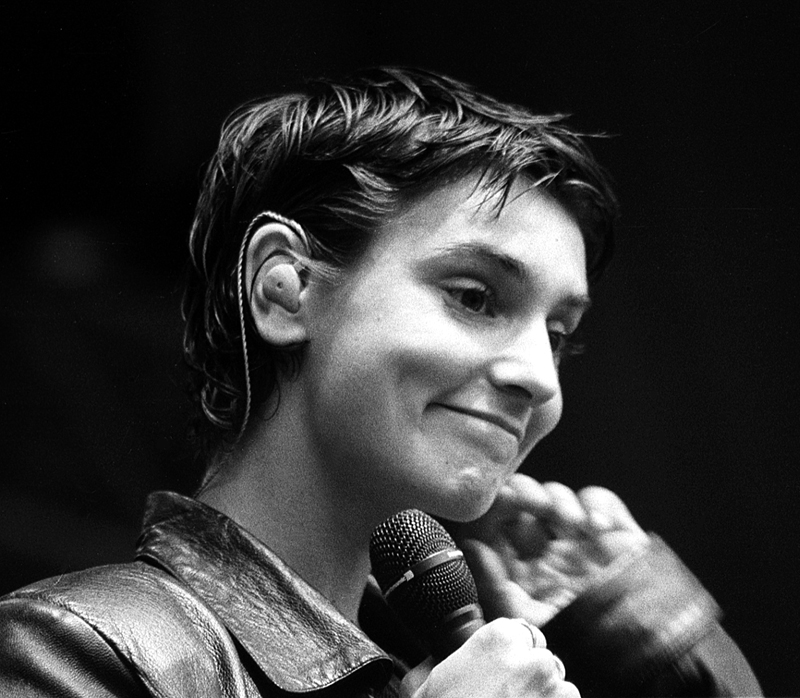
Which leads us to Steven Patrick Morrissey.
In a tribute posted on his website, Morrissey identifies with Sister Sinéad by addressing the “certain music industry hatred for singers who don’t ‘fit in’”(which of course he “know(s) only too well”); “…(T)hey are never praised until death – when, finally, they can’t answer back. The cruel playpen of fame gushes with praise for Sinead today … with the usual moronic labels of “icon” and “legend”.
There are two pieces of this i want to discuss specifically.
“Music CEOs who had put on their most charming smile as they refused her for their roster are queuing-up to call her a “feminist icon”, and 15 minute celebrities and goblins from hell and record labels of artificially aroused diversity are squeezing onto Twitter to twitter their jibber-jabber … when it was YOU who talked Sinead into giving up … because she refused to be labelled, and she was degraded, as those few who move the world are always degraded.”
And:
“Who cared enough to save Judy Garland, Whitney Houston, Amy Winehouse, Marilyn Monroe, Billie Holiday? Where do you go when death can be the best outcome?”
Obviously i do not know Morrissey, nor do i want to know him, or even meet him. That said, i detect a bit of projection from this piece. This man, who is notoriously right wing, racist and xenophobic, putting “feminist icon” in quotes can only be read from a tone or place of derision. i have seen a couple of right wing sources identify her as ‘anti feminist’, despite the fact that vast number of things she has done in her life and stood for were antipatriarchal. His evoking of Whitney Houston’s name was also interesting, given he once made this comment in 1986: “I hate all those records in the Top 40 — Janet Jackson, Whitney Houston. I think they’re vile in the extreme. In essence this music doesn’t say anything whatsoever. I don’t think there’s any time any more to be subtle about anything. You have to get straight to the point. Obviously, to get on Top of the Pops these days one has to be, by law, black.” In the same interview he said: “Reggae, for example, is to me the most racist music in the entire world. It’s an absolute total glorification of black supremacy… There is a line when defense of one’s race becomes an attack on another race and, because of black history and oppression, we realise quite clearly that there has to be a very strong defense. But I think it becomes very extreme sometimes.”
This is a man who supported Brexit and has lamented immigration in the u.k. (despite being from a family of Irish immigrants, and moving to Los Angeles and Rome, Italy): “The gates are flooded and anybody can have access to England and join in… Although I don’t have anything against people from other countries, the higher the influx into England the more the British identity disappears.”
This is a man who in a 2010 interview with The Guardian said with his whole chest, “You can’t help but feel that the Chinese are a subspecies,” due to his objection towards the treatment of non-humans.
This man is the polar opposite of everything Shuhada’ Sadaqat stood for and yet i see countless rationalizations and defenses of this man and his behavior… ‘because he makes good music.’ People who say they are against racism and hatred STILL listen to his music (yes, i am referring to his solo music, not the Smiths) and attend his concerts.
At what point do we demand both artist and listener to struggle and be decisive in their choices, if one truly claims they are against injustice? Steven Patrick Morrissey may very well be sincere in his tribute; if we ignore his history (and present tense) though, it may be harder to read between the lines.
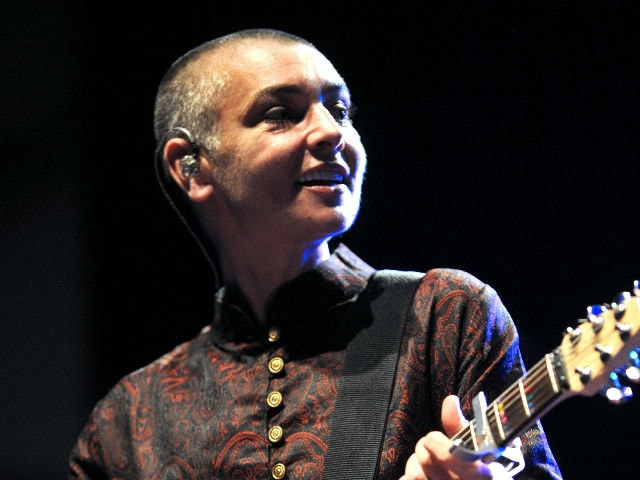
In terms of Sister Sinéad’s anti-racist leanings, there have been a number of pieces addressing her song ‘Black Boys On Mopeds’ (from one of my top 50 favorite albums of all time, 1990s I Do Not Want What I Haven’t Got– i have also quoted lyrics from the song earlier in this very post). The song addresses the targeted criminalization of African youth by the state, and the deaths that occur as a result.
The opening lyrics, regarding (prime minister) Margaret Thatcher’s indignation at what was occurring in Tienanmen Square in China, calls out her hypocrisy for her signing off on the same thing occurring in Britain (which of course, was once colonizer to China).
Margaret Thatcher on TV
Shocked by the deaths that took place in Beijing
It seems strange that she should be offended
The same orders are given by her
It fascinates me that out of the pieces addressing this song, there are mentions of George Floyd and Black Lives Matter (understandably); yet there is no condemnation of the system that presented a death of George Floyd to us. In a world where Joe Biden can deride antiqueer policies and enact sanctions against Uganda, but not impose federal repercussions onto u.s. states that that increasingly negatively impact the lives of queer, nonbinary and trans people. This is the country where people called Trump a racist (and make no mistake, he is) and yet ignore and support this same Joe Biden (under an Obama cabinet) who supported the usurping of a democratically elected government in Ukraine in 2014 (with folks like Victoria Nuland at the helm), replacing said government with very open neo nazis, who persist to this day. This is a country that has no problem with increasing funding and militarizing police (as well as remaining silent on the environmentally destructive and inhumane building of Cop City), as health care is still majorly privatized.
There’s so much, but discussing it all would take a whole other blog entry’s worth. i will just say this: the settler colonial status of the u.s. will never be dealt with, until there is actual acknowledgement that it sits upon stolen land. The u.s. is in no position to do any sort of moral posturing, when its objective is driven by the destabilization of any place around the world which rejects western-backed hegemony or subjugation- Cuba, Vietnam, Chile, Nicaragua, etc., and when the prison industrial complex is funded much more significantly than schools.
If they hated me they will hate you.

You may ask, what does all of this have to do with Sinéad O’Connor?
If you must ask this question, i insist you both read this piece again, as well as listen to her music.
As an organizer (who at times has had my voice shut down and/or minimized for being ‘too loud’), as a person who plays music as well as a person who struggles with mental health almost every day of my life (who sometimes contemplates, as well as have made attempts to end it all), Sister Shuhada’s life story is one i empathize with. This is but a humble tribute.
In some ways artists do help us connect to seeing that, as a play on a Sinéad lyric, all we’d need was inside us the whole time. Writing this helped me to process what it was i connected to, and why she was truly special. Like St. Anger (an album that has been similarly maligned), there is a beauty in her imperfection.
Stepping up and speaking out is scary. But it is necessary for our survival.
Sister Sinéad.
Sister Shuhada’.
Sister Magda.
You are now free of all labels. You are now all of these names, and none of these names. You have left us here, with your gift of principled struggle. Amid these dangerous days, may we take these lessons to heart. May you now be at peace, with your new family.


 the one woman apollo!